Dear Graham,
Casco Viejo is the historic quarter of Panama City, founded in 1673 after the original city, Panamá Viejo, was destroyed during the pirate attack led by Henry Morgan in 1671. After decades of decline, the neighborhood began an extensive restoration in the 1990s and has since become one of Latin America’s most atmospheric and charming historic districts.
When we arrived in January 2026, we found it charming—a place where colonial architecture, tropical air, and modern life exist side by side.
A friend from Boulder had recommended a restaurant there called El Nacional Sabores de Panamá on Plaza Catedral. Curious, we stopped in on our first day, even though we had already eaten. I noticed immediately the dishes being served—colorful, unfamiliar, and beautifully presented, each plate carrying a kind of quiet intention.
While looking around, I learned that El Nacional also offered cooking classes in a large open kitchen at the back of the restaurant. There I met George, the manager, an American who had lived in Panama for nearly twenty years. He had married a Panamanian woman, was now divorced, and was managing the restaurant.
Instead of signing up for a class there, George suggested something far more unusual. The next day, he said, he and the chef were taking a small group to an Indigenous village along the Chagres River in Chagres National Park, where we would cook traditional food with members of the Emberá-Wounaan community. He said we would not be disappointed.
The next morning, we met in front of the restaurant and climbed into a white van with George, the chef, and several other participants. The group felt unexpectedly familiar. A man sat beside us from Vancouver, where you and your family live, Graham, and a couple behind us was from Boulder, our hometown. The husband had once managed Mike’s Camera, where Tom and I had bought cameras and developed film back when photography still required film. It felt like a small, improbable convergence of lives from places we knew well, gathered in a country still new to us.
As we left Casco Viejo, the city shifted in layers. We passed through neighborhoods of wealth and then into areas of visible poverty—rows of aging apartment buildings, worn and crowded, standing in stark contrast to the polished city center. The transition was abrupt and unsettling, the kind that makes a place feel more real rather than less.
Gradually, the buildings gave way to dense green countryside. The air softened. Tall palms, broad-leafed trees, and flowering shrubs in reds, yellows, and pinks lined the road until we finally turned into the national park.
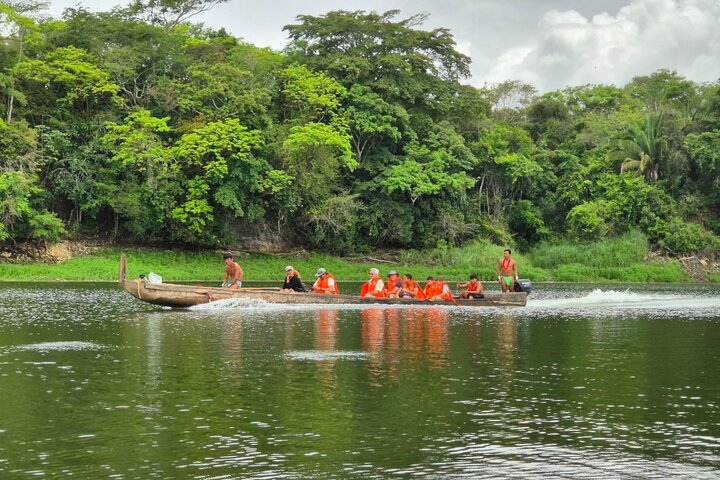
At the river, brightly painted wooden canoes waited along the shore, each fitted with a small motor. Emberá-Wounaan men stood beside them wearing traditional clothing—hand-dyed fabrics, beaded necklaces made of seeds and shells, and dark body paint across their faces and arms. They spoke among themselves in their language and in Spanish, with little English between them.
We split into two canoes and began moving downriver. The ride was quiet and steady, the city disappearing behind us as jungle closed in on both sides. Birds called from the trees, and the air felt cooler on the water. It was a relief simply to be moving through that landscape after the intensity of the city.
After some time, we arrived at the village and climbed a steep wooden staircase to an open-air community space beneath a thatched roof. Children ran through a small playground nearby. Gardens, chickens, and simple classrooms gave the place a feeling of the peoples everyday life.
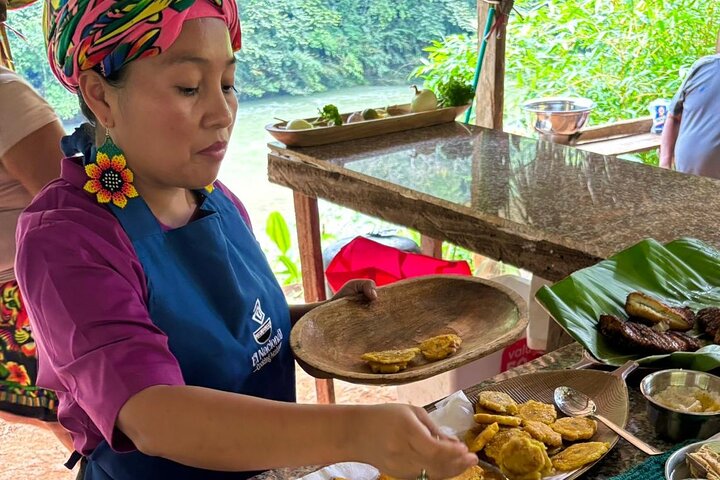
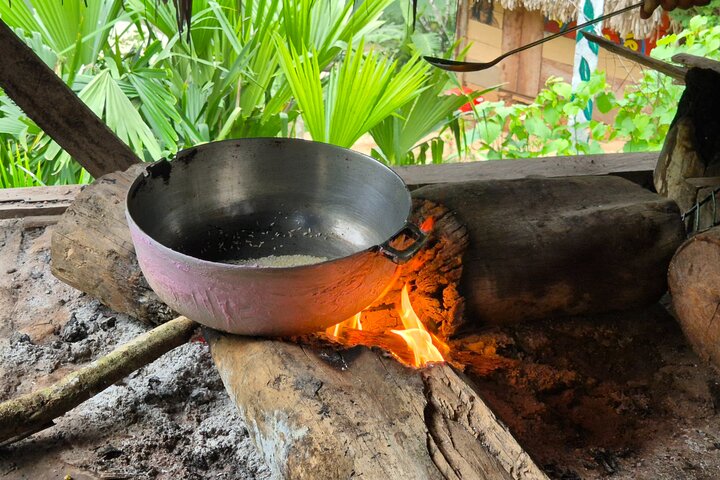
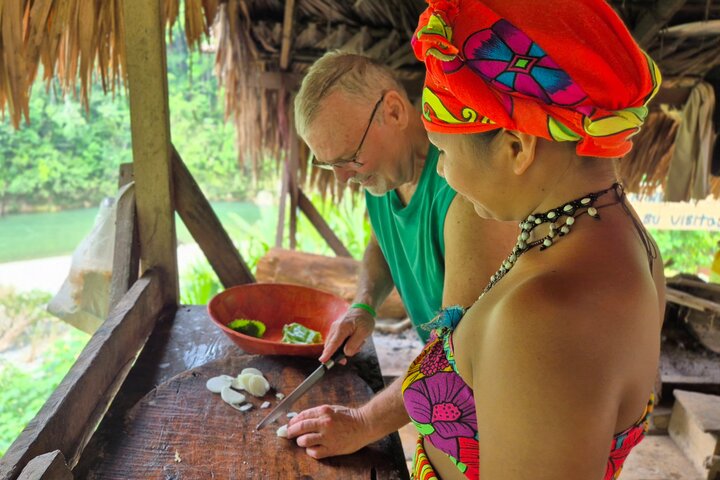
Our cooking class took place in a large open-sided kitchen with long wooden tables, an open-fire stove, and baskets of ingredients waiting to be used. Three Emberá-Wounaan women and the chef from El Nacional guided us through the preparation.
We began with chicken soup, learning to chop onions and peppers with care, working slowly over large wooden boards. Chicken from the village was prepared and added to a simmering pot over the fire. The rhythm of cooking felt unhurried and communal, shaped more by attention than instruction.
We then prepared plantains—sliced, flattened, briefly boiled, and then fried until golden. After that came empanadas made from ground corn dough. The corn was freshly milled, shaped into rounds, filled with seasoned chicken and onions, folded, sealed with our fingers, and fried until crisp.
When everything was finished, we gathered around the table and ate together. The food was simple, fresh, and satisfying in a way that felt connected to the place itself.
After lunch, we walked through the village, meeting residents and seeing handmade crafts—beaded purses, necklaces, belts, and woven textiles. There was a quiet dignity to the daily life unfolding around us.
Later, we returned downriver by canoe and then by van to Casco Viejo. Along the way, George explained that the Emberá-Wounaan originally came from the Darién rainforest and had relocated to the Chagres River region about fifty years earlier, establishing new communities while maintaining elements of their traditional way of life.
By the time we returned to the city, the experience felt less like an excursion and more like a brief crossing into another world—one that was still fully present, not preserved or staged, but lived.
Graham, the cooking class was far more than a lesson in preparing food. It was a cultural exchange that allowed us to spend time with people whose lives are shaped by a world very different from our own. It remains one of the most meaningful experiences of our life in Panama.
With love,
CC