Dear Graham,
Another Saturday adventure with Tom, Rentia, and me.
This time we agreed to drive to La Arena, a tiny artisan village just a few minutes from Chitré, to visit the pottery shops. I had heard about them from two Canadian women and was curious to see what all the fuss was about. I really didn’t know what to expect, but I thought it would be fun to explore and discover. Rentia and Tom willingly joined me on this magical mystery tour.
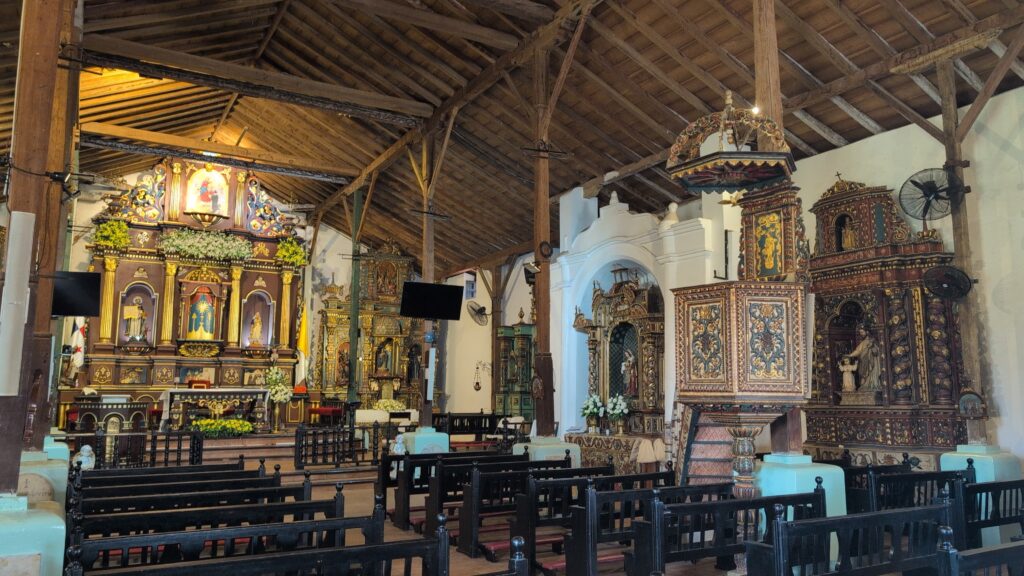
It took a little over an hour to reach Chitré. Along the way, Tom accidentally missed a turn. Once again, we found ourselves in front of the charming white adobe chapel with its tall steeple. I say “once again” because this was the very same church we had stumbled upon during our nighttime lost adventure in Chitré more than a month ago.
That evening we had arrived just as a bride and groom emerged from the chapel. The lights of the altar glistened behind them while fireworks burst across the sapphire sky above. It was one of those unforgettable travel moments. Tom and I had talked about returning someday to see the church in daylight, and here we were again, delivered to its front door by a wrong turn.
I am beginning to think there are no wrong turns in life—only detours that bring unexpected blessings.
The door stood open, and the three of us stepped inside the sweet, holy space. The small church featured a wood-beamed ceiling and a wooden altar trimmed in gold. I admired the stained-glass windows, dark wood details, frescoes, and statues of Mary, Jesus, and various saints. Yet even more striking than its beauty was the profound sense of peace that filled the sanctuary.
The church’s story dates back to the 1890s, when the growing town of Chitré wanted a larger and more beautiful place of worship than its original chapel. The cornerstone was laid in 1896, and after years of community effort, the church was blessed in 1910 on the feast day of Saint John the Baptist, the town’s patron saint.
One of the pleasures Rentia, Tom, and I discovered—and one that surprised me—was the historic district surrounding the cathedral. Rather than standing as an isolated monument, the church sits within a charming old town filled with broad streets, shade trees, and low-rise buildings that invite strolling rather than rushing.
We wandered up and down the streets admiring one- and two-story buildings with deep verandas, decorative cornices, broad windows, and beautiful red-tiled roofs.
At one point I spotted a tiny museum tucked into a row of old houses sharing a covered veranda. The front door was secured with a wrought-iron gate, and the place appeared closed. Then, as if on cue, a man emerged from the neighboring house carrying a set of keys. He unlocked the gate and warmly invited us inside.
The front room was packed floor to ceiling with elaborate devil masks created by artisan José González. Without realizing it, we had wandered directly into his workshop.
Another room displayed traditional Panamanian folk art, including polleras, the country’s elaborate national dresses, along with jewelry and tembleques, the delicate floral headpieces worn with the dresses. The three of us were delighted by this unexpected discovery.
What do you call a day that unfolds far beyond your expectations, when all the pieces seem to fall into place in surprisingly delightful ways? Synchronicity, perhaps—a meaningful alignment of events that feels more significant than mere coincidence.
That was exactly how our Saturday adventure was turning out.
Eventually we continued on to La Arena. Rentia sat in the back seat navigating with Google Maps. The first pottery shop we found looked promising, but unfortunately it was closed. A young woman standing nearby suggested there were smaller shops farther up the street.
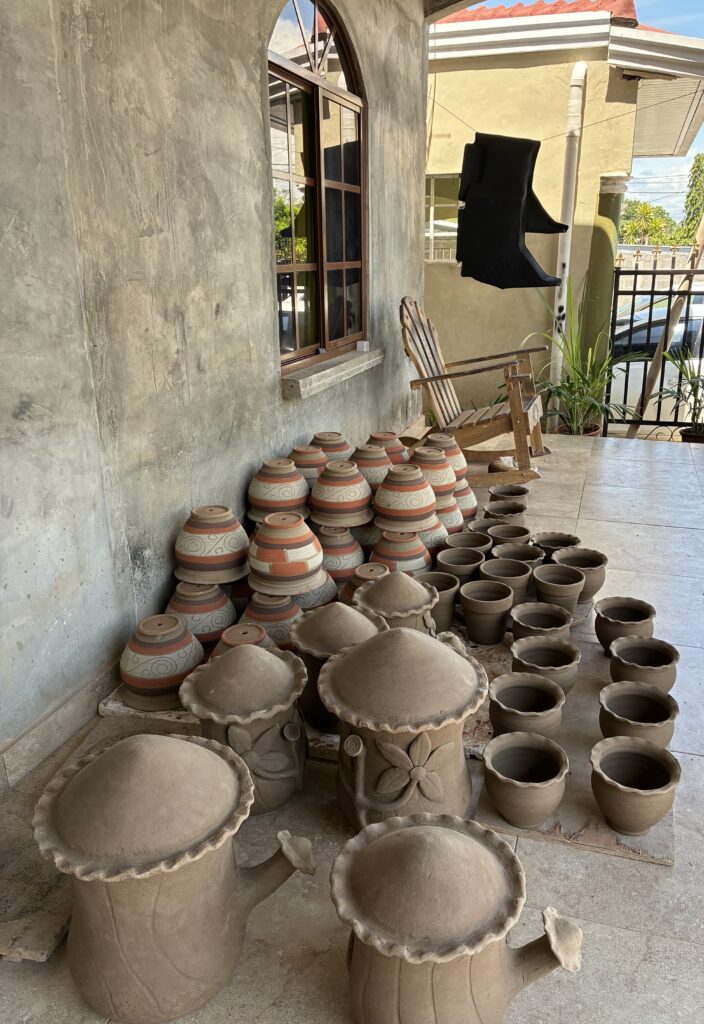
Rentia then found another location tucked off the main road. It turned out to be a working pottery studio. Wet clay pots sat drying in the yard, and rows of painted flowerpots waited to be fired. In the backyard stood a massive brick kiln. The artist and her husband attempted to explain their process in Spanish. Considering my Spanish is nearly nonexistent, I was surprised by how much I thought I understood.
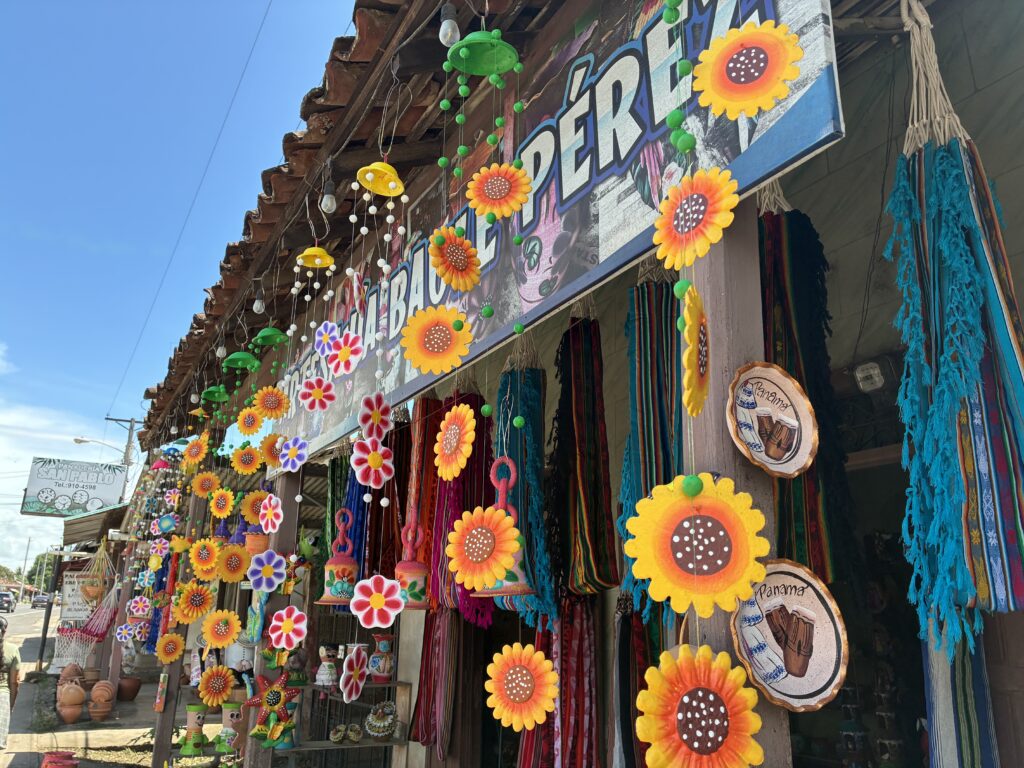
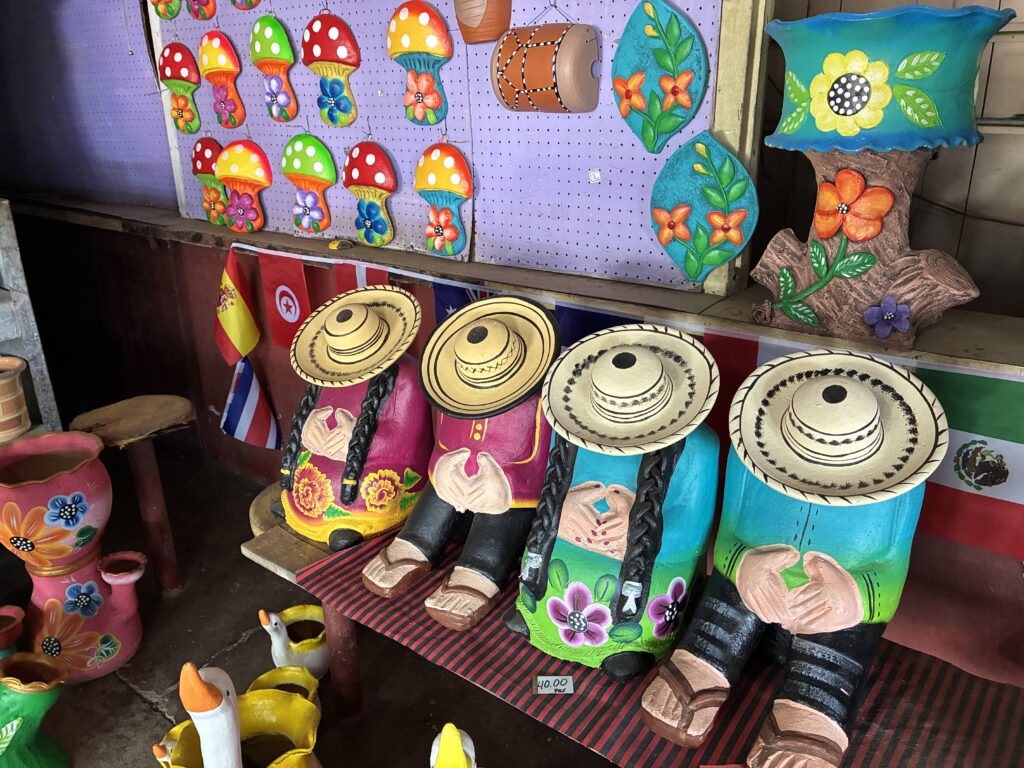
Back on the main street, we visited several galleries filled with pottery and handwoven hammocks. I was charmed by the whimsical folk art. I had expected bowls, platters, and coffee mugs. Instead, I found colorful mushroom sculptures, strings of ceramic flowers and suns, parrots, owls, turtle chimes, decorative jars, and brightly painted vases.
The craftsmanship was impressive. The pottery displayed a consistency and quality of firing that reflected generations of experience. La Arena has long been recognized for its master potters, whose folk-art creations are among the cultural treasures of the Azuero Peninsula. Their work is admired throughout Panama and beyond.
We ended the day at a restaurant in Las Tablas that a friend had recommended. Donde Mario’s was charming, both in setting and atmosphere. Rentia won the “best pick of the day” award with a beautiful seafood paella bowl. I wish I had followed her lead. Tom and I ordered tuna in tomato sauce, which was wholesome and tasty, but Rentia’s dish was the clear winner.
A good time was had by all.
We had packed our swimsuits for a planned beach walk at Playa Candelaria, a place we had been hearing was “amazing” for nearly a month. Somehow, we never seem to make it there. We didn’t get there on this trip either. Instead, we opted for chocolate ice cream in Pedasí and the pleasure of arriving home by four o’clock.
A small postscript to this story: when we returned home to Desilarderos, Tom and I suddenly noticed that we had been living with examples of La Arena artistry for months without realizing it.
In the front yard stands a beautifully painted ceramic mushroom created by one of the La Arena artists. In the dining room is a large owl sculpture remarkably similar to one I had admired in the galleries. And hanging on two hooks on the back veranda is a colorful woven hammock much like those displayed on the porches of the artisan shops.
The owners of our home are both artists and collectors who clearly appreciate fine craftsmanship, so it makes perfect sense that they had chosen pieces from this famous artisan village. Yet somehow, we had never connected the dots. We had been surrounded by La Arena’s artistry all this time, unaware of its origin until the very day we visited the place where it was created.
Perhaps that was one more small example of the synchronicity that seemed to accompany us throughout the day.
A great day.
With Love,
CC